As an Amazon Associate, we earn from qualifying purchases. Some links on this site are affiliate links at no extra cost to you. Our recommendations are based on thorough research and editorial judgment.


Ancient Egyptian Undergarments Discovered

Overview: Archaeologists recovered linen undergarments and pleated tunics, some repurposed as mummy bandages, from Deir El-Bahri and other sites. Details: fragments show fine pleats, running and whip stitches, resin and starch coatings, and evidence of wear and repair. Types: loincloths, wraparound kilts, and tunics provided breathability, modesty, and ritual purity. Consequences: chemical analysis dates textiles, traces trade in exotic resins, and indicates embalming practices. Continue for more specifics and context, including visuals and lab results.
Key Takeaways
- Archaeologists found linen undergarments, including loincloths and wraparound kilts, among burial textiles excavated at Deir El-Bahri in 1909.
- Undergarments were lightweight linen, breathable like modern cotton, suited for daily wear and ritual purity across genders.
- Worn garments were often repurposed as mummy bandages, with evidence of cutting, folding, and resin saturation.
- Fine pleating, gum or starch treatments, and sewing techniques indicate status distinctions and advanced textile craftsmanship.
- Chemical analyses (GC‑MS) of resin-coated linens reveal embalming materials, dating clues, and long-distance resin trade links.
Discovery at Deir El-Bahri
You may be interested


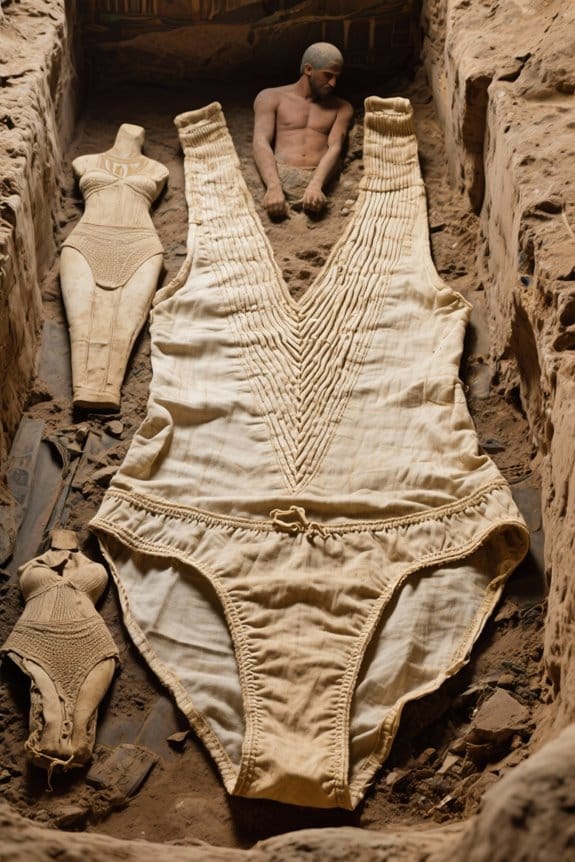
The reader should understand the basic find and why it matters, because the context explains both daily use and funerary practice. Find Details:
- Excavated in 1909 at Deir el-Bahri by Howard Carter and Lord Carnarvon, in a rock-cut court with sepulchral chambers.
- The woven linen bag-tunic showed waist wear from a belt, repair darning, and folding, indicating repeated use and storage.
Context and Significance:
- Over 300 funerary textiles were found, some two meters long, retaining color, showing burial significance and embalming use.
- Mummy bandages reused garments, some resin-coated, others pleated, linking daily dress to ritual.
Practical Notes:
- Footprint suggests barefoot embalmers worked in hot, crowded conditions during mummification.
- Repairs indicate habitual wear, skilled menders preserved functional textiles daily.
These finds highlight parallels with modern high-waisted designs that prioritize comfort and support in undergarments.
Seven Pleated Linen Fragments

– Evidence from seven finely pleated linen fragments, preserved for roughly 4,000 years, shows repeated pleat formation, material treatments, and partial reuse in funerary contexts. The fragments reveal ancient craftsmanship and textile symbolism through technique, use, and context.
Pleating techniques:
- Sharp, parallel pleats about 2 mm deep, formed by weave density, thread arrangement, and wetting/drying cycles, producing stiff protruding folds.
- Polysaccharide traces suggest natural gums or starch aided pleat retention; no synthetic stiffeners detected.
Functional and social roles:
– Pleating increased airflow and movement in hot climates, marked luxury and status, and appears in tomb art.
Conservation note:
– Some fragments carry resin saturation, indicating reuse in burial practice.
Measurements match pleated garments in New Kingdom tomb scenes, suggesting commissioned production for elites and ritual display purposes. cotton blends are favored for their softness and breathability.
Mummification Balms and Resin Analysis

Evidence of resin-saturated linen fragments in burial contexts connects textile reuse to the chemical practices of mummification, prompting focused analysis of balms.
Overview and methods
- GC-MS and molecular fingerprinting identify beeswax, plant oils, animal fats, conifer resins, and pistacia, dammar, cedar, juniper/cypress components, and bitumen.
- Radiocarbon dating and biomarker analysis distinguish natural from added bitumen, and source regions.
Findings and implications
- Workshop vessel residues show layered mixtures, repeated use, and storage of embalming substances, influencing conservation decisions.
- Bitumen rises in later mummification techniques, especially Ptolemaic high percentages, while earlier balms contained minimal bitumen.
- Exotic resins imply trade links, and heated resins indicate deliberate preparation during embalming rituals.
- Multiple samples per object provide reproducible chemical profiles, guiding dating, provenance assessment, and conservation treatment choices protocols.
Recent conservation strategies also draw on modern studies of moisture-wicking fabrics to inform handling and storage of resin-saturated textiles.
Textile Coatings: Gum Arabic and Starch
One should recognize that gum arabic and plant starch were deliberately applied to linen, to stiffen fabric, hold pleats, and improve wear resistance.
Overview: Gum arabic, from Acacia, and starch, from barley or wheat, were practical coatings used in garment production.
- Purpose: stiffening, increased durability, easier cleaning, and textile preservation for burial and ritual clothing.
- Application: water-soluble binders applied to surface, altering texture and finish without damaging fibers.
- Effects: crisp texture, gloss, maintained volume, signaled status through color symbolism and visual refinement.
- Evidence: archaeological traces on textiles, tomb art depiction, and preserved pleated linen in museum collections.
Consequences: plant-based coatings supported longevity, ritual purity, and affordable local sourcing.
These practices inform conservation methods and guide experiments reconstructing authentic ancient textile treatments used in museums.
Modern comparisons show that Gum arabic and plant starch function similarly to some contemporary fabric finishes used to stiffen and protect textiles.
Recommended Products

Strengthen art projects with starch

CRISP CLEAN FINISH: Love the feel of a crisp pair of clothes? You can bet on Starch for a crisp classic finish on your button-ups, pants, slacks and shirts.

QUICK & EASY IRON AID: Let your clothes come out sharp, crisp and wrinkle-free with Faultless? iron out spray. This spray starch is the original hold formula, which is light yet effective. This iron spray for clothes contains an iron aid, making it easier and faster for iron to glide on fabrics.
Pleating Techniques and Practical Benefits
Pleating techniques combined practical methods and material choices, and the reader should understand key processes that produced durable, airy garments.
Methods
– Plissé folding used heavy molds or weights to fix pleats, produced by wetting, pressing, drying, preserving shape.
Weaving
– Some pleats formed during weaving by gathering weft threads, others by knife pleating with heated tools, creating sharp folds.
Materials
– Fine linen, yarn twist, and extra yardage enabled crisp pleats, improved airflow, prevented clinging in hot climates.
Maintenance
– Repeated pressing, pleating boards, possible stiffeners were needed to retain shape, reflecting labor and status in ancient craftsmanship and textile evolution.
Consequences
– Pleats increased mobility, cooled the body, suggested rank, required resources and time, thereby linking clothing to social display.
Examples appear in tomb art, found textiles. Many modern shapewear benefits such as seamless construction echo ancient concerns for smooth silhouettes.
Recommended Products
flare pants for women fleece penguin pants women’s pajama pants long bell bottom pants black dress pants for women work korean women clothes black straight pants for women sweatpants womens blazer and pants set womens sweatpants baggy blue yoga pants for women plus size stretch khaki pants baggy plus size pants cotton sweatpants pink capri pants for women womens wide leg work pants cross waist yoga pants straight leg slacks women swimsuit coverup pants for women dressy jogger pants for women gr

Upgraded Removable Butt Pads: Our butt lifter shapewear features detachable buttocks pads have been upgraded with a wider, thicker 360° wrap design that completely covers your buttocks, creating an instant bigger butt effect. The butt pads for bigger butt are washable, reusable, and secured in individual pockets to prevent shifting. This booty lifting panties enhances the curve of your buttocks and shapes them naturally, no one will notice you're wearing fake butt.

light pink dress for women house dress with pockets long sleeve dresses for fall dress with built in shapewear womens formal dresses for wedding white dress women elegant plus size formal dresses curvy women wedding guest dress midi club dress black dress socks white summer dresses for women fall wedding guest dresses long sleeve work dresses womens golf dress midi dress with slit faux leather dresses for women 2026 dress for graduation ceremony women blue and white dress for women dresses long
The Tarkhan Dress and Earliest Woven Clothing
Although buried and overlooked for decades, the Tarkhan Dress has been radiocarbon dated to about 3482–3102 BCE, making it the world’s oldest surviving woven garment and a clear indicator of advanced textile skills in late Predynastic Egypt. Tarkhan significance: The garment shows linen usage, tailoring from three panels, knife-pleating, and V-neck construction, proving complex production methods. Woven craftsmanship: Materials and joinery indicate systematic spinning, weaving, and sewing, implying specialist makers and social differentiation. Key facts:
- Provenance: excavated 1913, conserved 1970s, housed at UCL Petrie Museum.
- Dating: refined Oxford radiocarbon test, predates First Dynasty.
- Function: likely worn in life by an elite youth, later used funerarily.
Consequences: early textile industries influenced social roles, trade, and dress continuity. Studies continue to reveal techniques. Contemporary adaptive designs also prioritize breathable materials and easy closures to enhance comfort and usability.
Types of Undergarments: Loincloths, Wraparounds, and Early Underwear
Following the Tarkhan Dress discussion, attention turns to common undergarment types used across ancient Egypt, and how they functioned in daily life and ritual contexts.
Overview: Linen loincloths formed basic underwear, simple triangles or rectangles wrapped and tied, offering breathability and symbolic purity.
Loincloths and variants: Loincloth variations included folded, layered, or pleated forms, worn by men and sometimes women, adjusted for comfort and modesty.
Wraparound styles: Wraparound styles produced kilts and skirts, belted over loincloths, varied by class and occasion, could expose or conceal as desired.
Early underwear: Specialized pieces like the subligaculum added support, leather appeared in pre-dynastic contexts, fine linen signaled elite status.
Practicality guided design, prioritizing cooling, ease of movement, and simple care for daily labor and ritual purity, and comfort. Designs also emphasized breathability, much as modern cotton and linen undergarments prioritize airflow and comfort.
Recommended Products
![Edoten] Fundoshi made in Japan 100% Cotton loincloth comfortable underwear Seikaiha(NavyBt)](https://m.media-amazon.com/images/I/519NBTmCVWL._SL500_.jpg)
Japanese classic pants.Fashion under wraps is what defines a true trendsetter. Try out the Etchu Fundoshi (loincloth). You will only find this design at Edoten. It is our original Fundoshi design.

This Ecchu Fundoshi loincloth is made in Japan using the Rien-Zome dyeing method. It is made of 100% high-quality cotton and is comfortable to wear. It is breathable and does not get stuffy easily. It is also recommended for those who are concerned about the tightness of elastic underwear or rashes caused by chemical fibers.

100% fine linen Spring and Summer White boxers; high quality soft premium innerwear; classic button fly with pull on closure; odor resistant wrinkle free material; quick dry lightweight anti chafing organic drawers; hot warm weather undies
Sewing Versus Wrapping: Garment Construction Methods
One clear distinction between sewing and wrapping lies in their construction methods, which shaped fit, durability, and social use.
Overview
- Wrapping relied on garment draping of large rectangular cloth, requiring minimal seams, enabling ventilation and easy adjustment.
- Sewing used simple sewing techniques like running and whip stitch, with needles of copper, bronze, silver, or bone, producing straight seams and tube dresses.
Consequences
- Wrapped garments frayed less due to weave tightness, were cooler in hot climate, and suited commoners.
- Sewn garments allowed tighter fit, finer transparent linen for elites, but needed more skill and time.
Practical Notes
- Edges often left raw, few hems used, flat-felled seams rare, fraying controlled by draping and fabric quality.
- Tube dresses showed simple seams allowing fitted shapes for elite wear.
Contemporary guides often recommend fabrics such as modal blends for softness and moisture-wicking.
Linen Production and Flax-Based Textiles
Because flax thrived in Egypt’s post-flood soils, its cultivation and processing formed the backbone of linen production, shaping textile strength, appearance, and social importance.
Cultivation and Harvest
– Farmers pulled, not cut, plants to preserve long fibers, improving fiber quality; bundles were sun-dried then retted in water for about two weeks.
Processing and Spinning
- Retting loosened bast from woody core; drying and beating removed coarse matter, careful timing guaranteed pliable strong fibers.
- Fibers were combed, lightly twisted, then spun on weighted spindles; spinning methods produced variable thread thickness, from coarse work cloth to fine royal linen.
- Vertical looms wove varied textures; starching and pleating adjusted stiffness, quality reflected social status.
- Practical consequence: finer yarns required more time, raising cost and status associations in elite contexts.
Modern comfort standards emphasize breathability in undergarment fabrics.
Reuse and Repurposing: From Clothing to Mummy Bandages
Examine how Egyptians converted worn linen garments, bedding, and household cloth into mummy bandages, combining economy, ritual need, and material value.
Sources and Practice
– Embalmers tore tunics, sheets, and blankets, using worn-out household linens when available, because linen was valuable and reuse was practical.
Evidence and Examples
– Archaeological finds show garments cut for wrappings, including a woman’s tunic reused as bandages, and household linens from relatives.
Types and Significance
– Most bandages were quality linens, sometimes second-hand, which became sacred textiles in mummification practices, conveying purity and wealth.
Special Cases
- Royal burials sometimes used purpose-woven bandages, while later periods added inscribed, magical bandages to protect the deceased.
- Practical and symbolic reuse reduced waste, preserved value, and linked living households to afterlife care. This informed ritual.
Royal and Elite Clothing Styles and Embellishments
Royal wardrobe features, such as finely pleated schentis, embroidered hems, and jeweled sandals, signal rank through material, technique, and decoration.
Materials and Craft: High-quality linen, pleating techniques, and embroidery techniques created garments that lasted and displayed wealth, the royal fabrics showing superior construction and preservation.
Common Styles: Triangular loincloths, sleeveless tunics, white head scarves, and belts formed core undergarments, while schentis and starched kilts added structure.
Embellishments and Meaning: Colored threads, gold studs, tassels, and jeweled sandals signaled social symbolism, they raised price and marked status.
Consequences: Access to sheer fabrics and pleated sleeves was limited to elite ranks, creating visible class differences and reinforcing hierarchy through clothing choices. Archaeological finds like Tutankhamun’s cloths provide clear, dated evidence for these practices, and for techniques.
Many garments incorporated breathable fabrics like linen to enhance comfort in the region’s hot climate.
Cultural, Religious, and Environmental Roles of Linen
Linen held central roles in Egyptian life, serving practical, economic, and sacred functions across daily and ritual contexts.
Cultural significance
– Linen marked purity and wealth, elite garments and burial cloths signaled status, reused for offerings and statue wrappings.
Religious roles
– Priests wore linen for ritual purity, mummies were wrapped in linen bandages, some inscribed with texts to aid afterlife passage.
Environmental adaptation
– Flax grew along the Nile, linen’s breathability and light color reduced heat stress, making it practical for clothing, bedding, and sails.
Practical consequences: linen’s labor-intensive production increased value, it functioned as currency and trade good, its sacred uses reinforced social hierarchy and funerary beliefs.
– Economically, households conserved garments, linen was taxed and paid to workers, quality determined social mobility.
Detailed records survive.
Frequently Asked Questions
How Were Undergarments Laundered and Scented for Hygiene?
Laundry methods used Nile water, soaking, pounding, natron and alkaline mixtures; garments were rinsed, wrung and folded to preserve pleats. Scenting practices employed floral oils and perfumed waters to freshen textiles and consequently denote cleanliness.
Were Dyes or Colors Used Specifically for Underwear?
No, like a blank linen, evidence suggests Egyptians left underwear undyed; scholars note color symbolism and limited dye sources reserved for decoration or elite garments rather than routine undergarments, and hygiene reflecting practicality over display.
Who Manufactured and Sold Linen Undergarments in Ancient Egypt?
Household women and workshop artisans manufactured and merchants sold linen undergarments; female textile workers led linen production while specialized artisans and traders distributed garments through local markets and textile trade networks serving varied social classes.
Do Any Garments Retain Wear Patterns Indicating Individual Fit or Sizing?
No, surviving garments rarely retain wear patterns denoting individualized fit; garment construction favored rectangles and simple seams, so artful body adornment suggests idealized fit rather than archaeological evidence of precise sizing for actual individuals primarily.
Can Conservators Safely Reconstruct and Display Wearable Reproductions Today?
Ironically, they can, conservators employ rigorous conservator techniques and strict replica ethics to reconstruct wearable reproductions, balancing faithful methodology, documentation, and display safety while avoiding harm to originals and educating audiences through controlled, reversible practice.